
- About
- Residents
- New Residents
- Neighborhood Resources
- Request a Service – GoDublin
- Permits
- Code Compliance
- Community Noise
- Community Events
- Community Resources
- Envision Dublin Community Plan
- Facility Rentals
- Historic Dublin
- Parks & Recreation
- Safety
- Speed Management
- Veterans
- Volunteer Service Opportunities
- Voting & Elections
- Visitors
- Services
- Business
- Development
- Government
- Careers
- News
- About
- Residents
- New Residents
- Neighborhood Resources
- Request a Service – GoDublin
- Permits
- Code Compliance
- Community Noise
- Community Events
- Community Resources
- Envision Dublin Community Plan
- Facility Rentals
- Historic Dublin
- Parks & Recreation
- Safety
- Speed Management
- Veterans
- Volunteer Service Opportunities
- Voting & Elections
- Visitors
- Services
- Business
- Development
- Government
- Careers
- News
Review & Accountability
National Accreditation
The Dublin Police Department prides itself on the processes in place that review police officers, their actions and the internal affairs in order to hold the agency accountable to the public.
The Dublin Police Department has been nationally accredited by the Commission on Accreditation for Law Enforcement Agencies (CALEA) since 1990, demonstrating a long-standing commitment to professional excellence.
In 2018, the department achieved dual CALEA accreditation by also certifying the Northwest Regional Emergency Communications Center (NRECC).
March 2026:
The Dublin Police Department and Northwest Regional Emergency Communications Center (NRECC) once again earned national CALEA accreditation on March 14, 2026. This recognition is widely considered the “gold standard in public safety” and follows a rigorous review of training, operations and accountability practices.
The acknowledgement reinforces Dublin’s long-standing commitment to high-quality, reliable service for residents. To remain accredited, the Dublin Police Department and NRECC must take part in the reaccreditation process every four years. Read more here.
Public Feedback
The public is invited to provide input about agency operations through the CALEA public portal. Comments are submitted directly to CALEA and are reviewed during the agency’s on-site assessment.
The Accreditation Process
The Community & Professional Services Bureau within the police department focuses year-round on the accreditation process, led by the professional standards manager.
CALEA accreditation involves three key components:
- Annual reporting and statistics
- File reviews and leadership interviews
- An on-site assessment every four years
In 2022, Dublin Police earned its tenth law enforcement reaccreditation and its first communications reaccreditation.
- The department complies with 99% of applicable law enforcement standards (out of 460).
- NRECC complies with 96% of applicable communications standards (out of 207)
What Accreditation Means
The CALEA process serves as a framework to ensure the overall quality, accountability and professionalism of agency operations. It helps the department:
- Maintain clear, effective policies
- Compile data-driven reports to guide decision-making
- Conduct regular internal reviews and audits
Officers and staff use CALEA standards to continuously improve operations and deliver exceptional public safety services.
To read more about CALEA, visit their website.
Ohio Collaborative Law Enforcement Accreditation Program
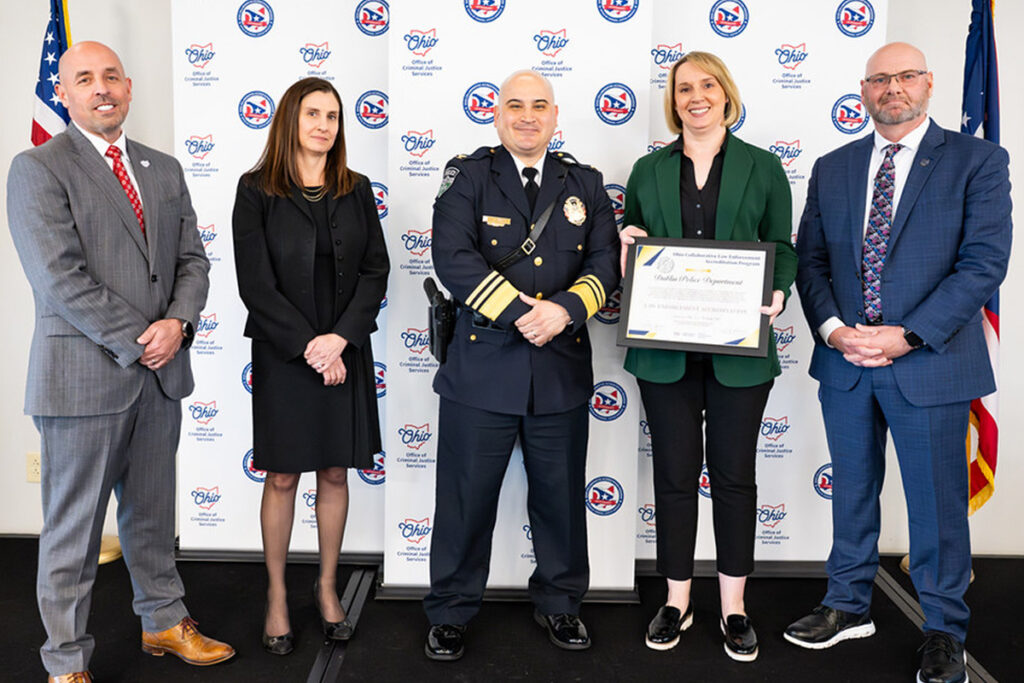
The Ohio Collaborative Law Enforcement Accreditation Program (OCLEAP) is the first statewide police accreditation program in Ohio — and the only state-administered, cost-free program of its kind in the United States. Designed to increase public trust and accountability, OCLEAP certifies law enforcement agencies that meet 31 professional standards reflecting best practices in modern policing.
Dublin’s Role in the Pilot Program
The Dublin Police Department was one of 10 agencies chosen to pilot OCLEAP from March 2024 to February 2025, with the organization officially accredited in February 2025. This achievement reinforces Dublin Police’s long-standing commitment to transparency, accountability and high-quality service.
Why Accreditation Matters
Accreditation aligns with Dublin Police’s mission of providing professional, community-focused public safety services. Accredited agencies are held to a consistently high standard that directly benefits community members:
- Improves transparency and accountability
- Ensures consistent service statewide
- Supports strong police-community relationships
- Enhances trust and public confidence
- Serves as a recruitment tool for top-tier talent
Leadership & Community Collaboration
Chief Justin Páez has served on the Ohio Collaborative Community-Police Advisory Board since 2020, representing the Ohio Association of Chiefs of Police. He played a leadership role in developing and launching OCLEAP, including participating in the March 2024 statewide announcement with Governor Mike DeWine.
“How we police is paramount to ensuring the public doesn’t hesitate for a single moment to call in their time of need.”
— Chief Justin Páez
Dublin Police officers continue to partner with residents to shape policies through initiatives like the Chief’s Advisory Committee, further strengthening accountability and transparency.
Building on a Strong Foundation
Dublin Police has been CALEA-accredited for more than 30 years, a national benchmark for excellence in law enforcement. Similarly, the Northwest Regional Emergency Communications Center (NRECC) has held CALEA accreditation since 2018, reflecting high standards in emergency dispatch.
By participating in OCLEAP, Dublin builds on its existing legacy of professional excellence to help shape the future of policing in Ohio.
Accountability
Motor Vehicle Pursuit Analysis
Each year, the Dublin Police Department conducts a documented analysis of motor vehicle pursuits. The purpose of this analysis is to provide any patterns or trends which would indicate a need for training or policy revisions.
Non-Bias-Based Policing Administrative Review
Each year, Dublin Police conducts a documented administrative review of traffic stops, complaints and suspicious person contacts to ensure compliance with the law and to determine any deficiencies.
In addition, data was analyzed to ensure gender and racial/ethnic characteristics were not being used against protected classes and minorities in traffic enforcement and self-initiated suspicious person contacts. Lastly, this report was used to determine if any patterns and/or trends exist that would require a need for further training or policy revisions.
Performance Evaluation
Annually, each Dublin Police sworn officer receives a written performance evaluation, as well as takes part in a structured discussion about their performance with their respective supervisor. The goals of these evaluations include:
- ensuring the public that the agency’s personnel are qualified to carry out their assigned duties,
- maintaining and improving performance,
- fostering fair and impartial personnel decisions,
- providing a medium for personnel counseling,
- facilitating proper decisions regarding probationary employees,
- identifying officer training needs,
- identifying unsatisfactory performance,
- and providing an objective and fair way to measure and recognize individual performance in accordance with prescribed guidelines.
In addition, probationary police officers are evaluated quarterly to ensure proper development, adherence to policy and procedure, and legal knowledge.
After the performance evaluation is completed by an officer’s supervisor (the rater), it is reviewed and approved by the rater’s supervisor to ensure consistency and accuracy.
Early Intervention System
The Early Intervention System (EIS) serves as the framework for establishing sound review processes, intervention when identified, and accountability that supports agency personnel. The purpose of the EIS is to
- identify employees who exhibit patterns of improper behavior and/or receive complaints.
- identify employees who may require additional training or remedial action to increase agency accountability.
- develop action plans to ensure the identified personnel have access to resources to effectively meet their job duties and offer employees a better opportunity to meet the agency’s values and mission statement.
The Dublin Police Department reviews the following for each individual officer on a trimester basis (every four months):
- Response to Resistance incidents
- Vehicle pursuits
- Internal affairs or complaints
- Discipline
- Employee counseling
Any employee who has three or more documented events within a four-month period will require, at a minimum, a review of their current evaluation file and a review of those specific events in an effort to identify or determine if a pattern of conduct exists that needs to be further addressed.
If this review does not satisfy the supervisor’s review and inquiry, the supervisor will meet with the employee to discuss their performance and/or behavior. This meeting will be conducted in an effort to determine or identify if a pattern of conduct exists and what intervention actions can be taken to remedy the situation (for example, counseling, progressive discipline, training, Employee Assistance Program, performance improvement plan, etc.). The supervisor will consider internal and external sources when developing comprehensive intervention plans. These plans should also consider prior efforts to remedy concerns and work in concert with other agency-endorsed actions.

Response to Resistance
The Dublin Police Department recognizes the value of human life and is committed to protecting those the department serves. Officers regularly complete training in de-escalation and response to resistance to ensure officers understand and effectively interact with the public. Training includes both classroom policy review and practical scenario-based exercises. Learn more.
- 2024 Response to Resistance and Subject Control Analysis
- 2023 Response to Resistance and Subject Control Analysis
Pursuit of Motor Vehicles and Forcible Stopping
The department’s vehicle pursuit policy aims to establish clear direction for officers, communications personnel and supervisors involved in a pursuit and address the conditions under which a pursuit can be initiated and conducted. This policy also addresses the use of forcible stopping techniques. Read the policy.
Internal Affairs and Complaint Process
In order to ensure public trust, transparency and the integrity of the agency, the Dublin Police Department thoroughly investigates all reports against the agency or its members.
The following are complaint classifications, which are investigated by the department:
- Anonymous complaint – Submitted anonymously
- Informal complaint – Complainant does not wish to formally pursue an allegation or complaint
- Formal complaint – Complainant wishes to complete a complaint form and pursue the matter
- Minor allegation — A minor allegation
- Serious allegation — A serious allegation
- Criminal allegation – A criminal violation of the law is or may be involved in the allegation(s)
- Serious misconduct – Conduct which could result in suspension or dismissal
The Chief of Police is directly responsible for the internal affairs function but may direct another supervisor (sergeant, lieutenant or deputy chief) to conduct all or part of an investigation. Typically, first-line supervisors will receive complaints and begin an investigation by meeting with the complainant and the involved officer(s) and gathering details. Depending on the seriousness of the complaint and the officer’s assignment, another supervisor may conduct the investigation.
After completing a thorough investigation, the investigating supervisor will provide a disposition (improper conduct, insufficient evidence to confirm or refute the allegation, policy failure, proper conduct by officer, unfounded complaint — officer exonerated, or unfounded — no further investigation possible).
The conclusion to each investigation is forwarded to the investigator’s supervisor, a bureau commander and the Chief of Police for review and final approval. Importantly, if a supervisor uncovers behavior or training needs during their review of a complaint that are not directly related to the allegation, they are expected to address these issues accordingly with the officer(s).
All internal investigations are completed within 60 days, unless the Chief of Police grants an extension due to extenuating circumstances.
Employee Recognition
Employee Recognition
The department is made up of professional and committed members who serve either as police officers or civilian employees. Members may be recognized for exceptional work or acts through the police department’s employee commendation program.
To start the process, any private citizen or employee of the Dublin Police may submit a letter of recommendation for an award to the Awards Committee. The committee then meets to review and discuss the nomination and, if approved, it is forwarded to the Chief of Police for presentation.
The Awards Committee includes police officers and civilian employees who have been appointed to the committee by the Chief of Police. Additionally, the department hosts an annual awards ceremony to recognize the protection, service and engagement of its members throughout the year.
The following are some of the awards employees may receive:
- Medal of Honor — Awarded to an employee who voluntarily distinguishes themselves by displaying extraordinary heroism and/or bravery
- Award of Valor — Awarded to an employee who is seriously injured or wounded during the apprehension or attempted apprehension of a suspect
- Life Saving Award — Awarded to any employee whose exceptional actions prevented the death of any person
- Chief’s Award of Excellence — A challenge coin issued by the Chief of Police to an individual employee or a team of employees who go above and beyond the expected and who exemplify the Dublin Police mission of excellence in service
- Award of Merit — Awarded for exceptional service to the community, or under adverse conditions, or while performing acts involving personal danger if the line of duty
- Award of Achievement — Awarded for exceptional service to the community or that significantly enhanced the efficiency of the department or significantly exceeding the expectations in the area of service to the community
- Certificate of Merit — Awarded to an employee who performs an action or actions not otherwise covered in the awards program; such action must exhibit outstanding diligence, perseverance, alertness or a highly credible accomplishment
- Leadership Award — An annual award given for demonstrating exceptional leadership in the agency
- Employee of the Year — An annual award given to one police officer and one civilian employee for their contributions to the agency and/or community, as well as for their overall performance: Officer of the Year and Civilian of the Year
- Military Service — Dublin takes great pride in recognizing employees who have served or are currently serving in the armed forces of the United States
- Volunteer of the Year — Awarded to a volunteer of the Dublin Police Department for their contributions to the agency and/or community as well as for their overall performance as a volunteer

Department Reports
As part of the agency’s ongoing commitment to transparency, the Dublin Police Department’s and NRECC’s most recent annual reports are posted. Activity reports include public complaints and internal affairs investigations.
Dublin Police Report
NRECC Annual Reports
2025 Quarterly Activity Reports
2024 Quarterly Activity Reports
- Summary of Internal Affairs and Complaints
- October – December
- July – September
- April – June
- January – March
2023 Quarterly Activity Reports
- Summary of Internal Affairs and Complaints
- January – March
- April – June
- July – September
- October – December 2023
2022 Quarterly Activity Reports
- Summary of Internal Affairs and Complaints
- January – March
- April – June
- July – September
- October – December
2021 Quarterly Activity Reports
Emergency
Phone: 911
Non-Emergency Service
Phone: 614.889.1112
Dublin Justice Center
Address: 6565 Commerce Parkway, Dublin, OH 43017
Phone: 614.410.4800 | Fax: 614.761.6535
Justice Center Hours: Open 24/7
Records Department Hours: Monday to Friday, 8 a.m. to 5 p.m.
Court Services
Phone: 614.410.4920 | Fax: 614.761.6598
Email Dublin Police
Contact the Dublin Police Department via email. This is NOT live-monitored.
Submit an Anonymous Tip
Submit an anonymous tip to the Dublin Police regarding crime.
Submit Traffic Complaint
Fill out a traffic complaint. This is NOT live-monitored.
Public Records Request Overview
In order to support faster response and better tracking of requests, the City of Dublin uses JustFOIA to collect, respond to and manage public information requests.
Why JustFOIA?
JustFOIA is a Freedom of Information Act (FOIA) online application that helps streamline the open records request process for the community and improve efficiencies in getting requested information quickly and accurately.
The application lets community members submit requests for all city records, including police reports. Commonly requested information includes accident reports, copies of resolutions and body-camera video.
Report an Issue
Request a service or report an Issue.
Tell Dublin
Send us your public input.
Dublin, Ohio, USA
5555 Perimeter Drive
Dublin, Ohio, 43017
Mon – Fri: 8 a.m. – 5 p.m.